Superpowers: give your coding agent great power — and great responsibility
AI can build almost anything now. 'Vibe coding' is that power with no discipline. Superpowers is a free, open-source framework that makes Claude follow a real engineering workflow — spec, TDD, subagents, and code review — automatically. Here's what it is, how to install it, and exactly how the workflow runs.
What's inside
- Vibe coding is a villain origin story
- What Superpowers is
- The workflow it enforces
- Practical application — building a real feature
- Sources & verification
The post, slide by slide
The Instagram carousel — save it or send it to someone who's still vibe coding.
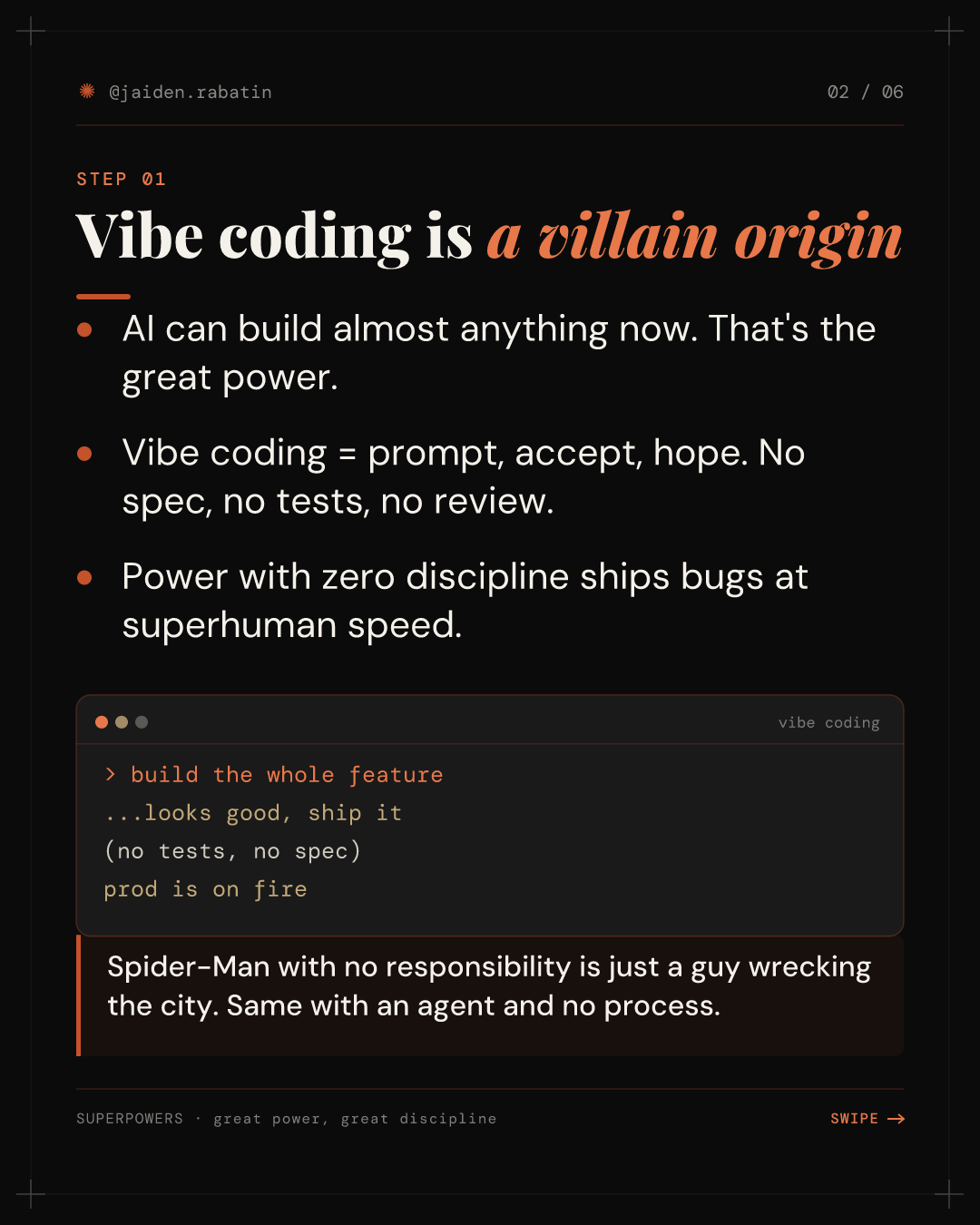
Vibe coding is a villain origin story
Coding agents crossed a line: they can scaffold features, wire APIs, and refactor modules on command. That is real power. The problem is how most people use it — what people now call 'vibe coding': prompt, glance at the output, accept, and hope. No specification of what 'done' means, no tests to prove it, no review before it ships.
Power without discipline doesn't make you a hero — it makes you fast at creating problems. An agent with no process will confidently produce code that looks right and breaks in production. The fix isn't a smarter model; it's a process the agent can't skip.
> build the whole feature
...looks good, ship it      # no spec
(no failing test written)   # no proof
prod is on fire             # no review
What Superpowers is
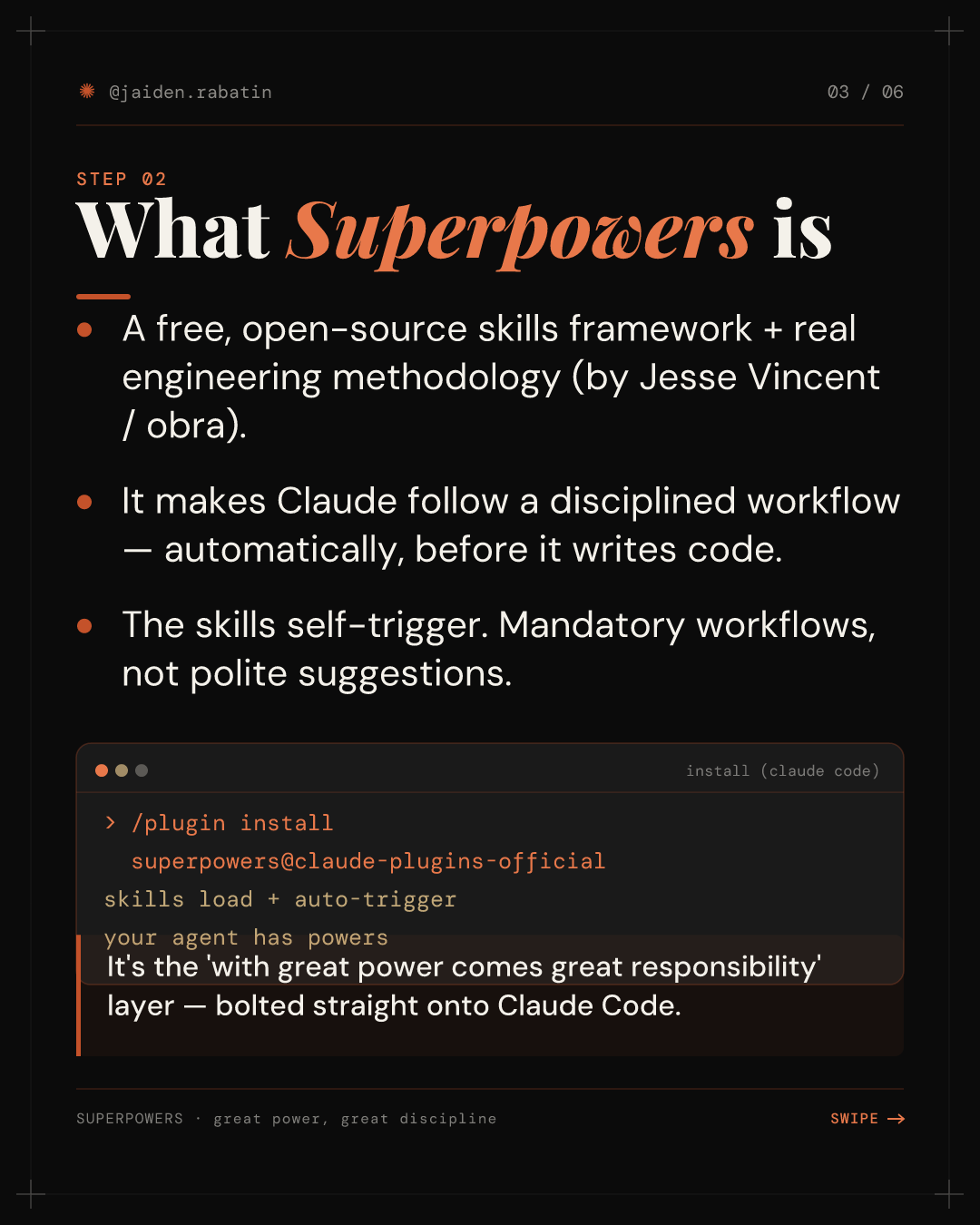
Superpowers is 'a complete software development methodology for your coding agents, built on a set of composable skills and some initial instructions that make sure your agent uses them.' It's free, open-source, and built by Jesse Vincent (obra) and the team at Prime Radiant. You install it once and the skills trigger automatically — the README is explicit that these are mandatory workflows, not suggestions.
In Claude Code, install it from Anthropic's official plugin marketplace. It also supports Codex, Gemini CLI, Cursor, Copilot CLI, and others — install it per harness. Heads up: the full workflow is token-heavy, so a Max plan or API usage is more practical than a base plan for end-to-end runs.
# Claude Code — official marketplace
/plugin install superpowers@claude-plugins-official

# or via the Superpowers marketplace
/plugin marketplace add obra/superpowers-marketplace
/plugin install superpowers@superpowers-marketplace
The workflow it enforces
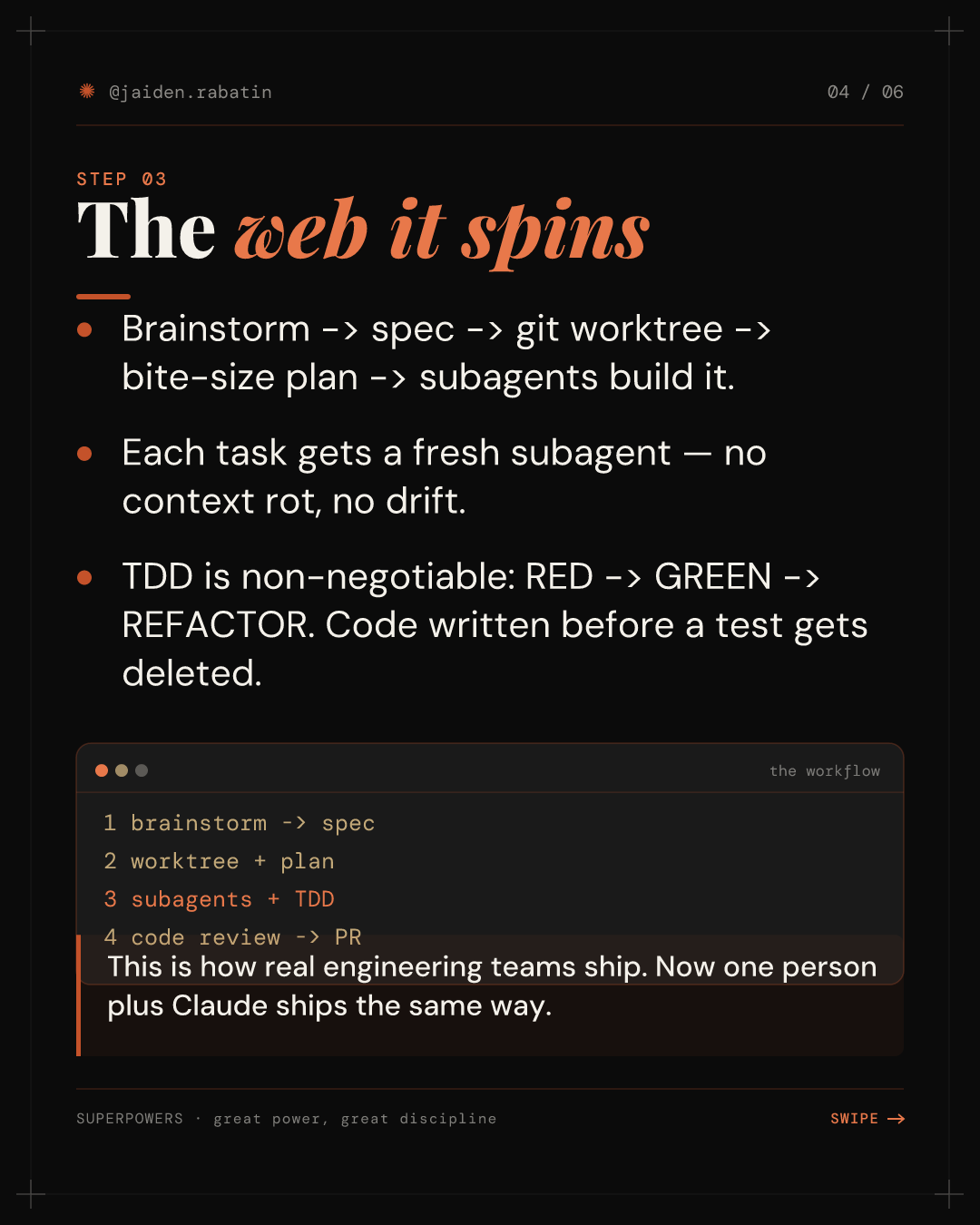
Superpowers runs a real engineering pipeline. (1) Brainstorming refines your rough idea through questions and shows the design back in chunks small enough to actually read. (2) using-git-worktrees creates an isolated branch with a clean test baseline. (3) writing-plans breaks the work into bite-size tasks (2–5 minutes each) with exact file paths and verification steps. (4) subagent-driven-development dispatches a fresh subagent per task — its own clean context window — so there's no context rot across a long build.
(5) test-driven-development is the heart of it: RED → GREEN → REFACTOR. Write a failing test, watch it fail, write the minimum code to pass, watch it pass, commit — and any code written before its test gets deleted. (6) requesting-code-review checks the work against the plan between tasks and blocks on critical issues. (7) finishing-a-development-branch verifies the tests and gives you merge / PR / keep / discard options, then cleans up the worktree.
brainstorm  -> spec (you approve in chunks)
worktree    -> isolated branch, clean baseline
plan        -> bite-size tasks, exact file paths
subagents   -> fresh context per task
TDD         -> RED -> GREEN -> REFACTOR
review      -> blocks on critical issues
finish      -> merge / PR / cleanup
Practical application — building a real feature
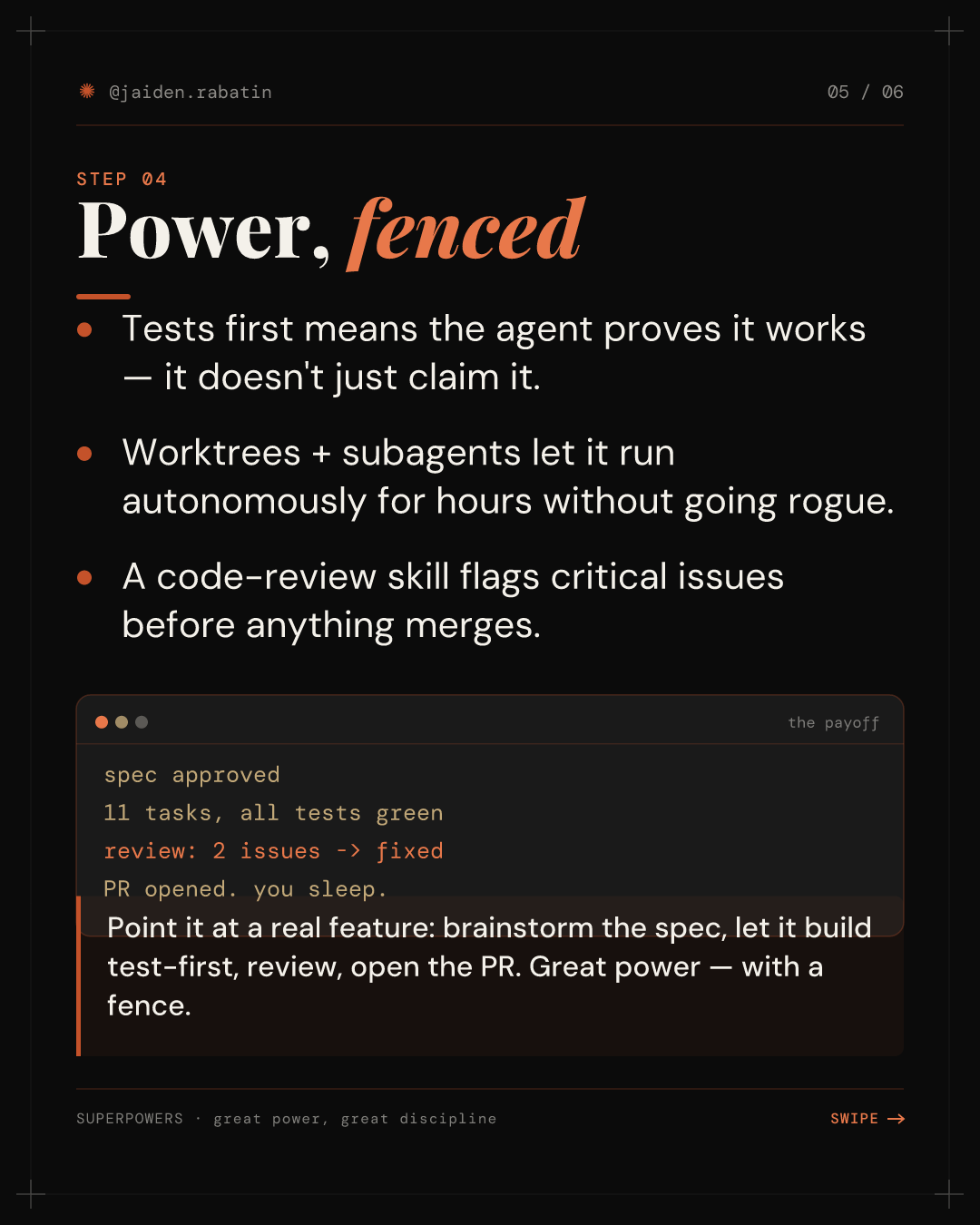
Here's the concrete payoff, from a real walkthrough (Eric Tech built a Google-Drive resync feature on a production app, BookZero.ai, end to end): paste the ticket, let Superpowers brainstorm a spec with interactive mockups, approve it, and it generates an 11-task implementation plan. You pick subagent-driven execution; it spins a worktree and runs each task with a fresh agent, test-first. When all tasks pass, it runs an automated code review, catches a couple of critical issues, dispatches a fix agent, and leaves you a clean branch to smoke-test and merge.
The point isn't the demo — it's the shape. Tests-first means the agent proves it works instead of claiming it. Worktrees plus subagents let it work autonomously for a couple of hours without drifting from the plan. And the review gate means problems get caught before they reach main. That's the difference between an agent that's fast and an agent you can trust.
spec approved
11 tasks  -> all tests green
review    -> 2 critical issues -> auto-fixed
branch    -> smoke test -> PR
you       -> review the diff, not every keystroke
Sources & verification
Grounded in the official project and a hands-on tutorial, verified 2026-06-22. Primary: github.com/obra/superpowers (README — definition, install commands, the 7-skill workflow, philosophy) and the release announcement at blog.fsck.com/2025/10/09/superpowers. Practical walkthrough: Eric Tech, 'Claude Code + SUPERPOWERS = The End of Vibe Coding?' (youtu.be/TX91PdBn_IA). Movie release date (July 31, 2026): marvel.com.
A full link-by-link source list lives at jaidenrabatin.com/sources/superpowers.md so any claim here can be traced to its primary source.
The Superpowers Quickstart + Workflow Cheat Sheet
Install commands, the 7-skill workflow, the TDD cycle, and when to reach for it — one page to end vibe coding.